
DJALCHEMI
28 November 02005
Does music have a genome?
Alongside the Last.FM model of personalised online radio (which I covered at some length and have cited in several other posts), Pandora provides an alternative based on different technology and classifications:
We take your input (artists, songs) and feedback ("I like this", "I don't like this") and use the Music Genome Project™ to create stations that play songs that are musically similar to what you've told us. That's it; only the music counts. We don't care how popular the artist is, who's backing them, and we don't care which genre bin they usually belong in. Only the music matters. [Source]
Sounds good — and Pandora is now getting referenced in guides to online sources for finding new music, having more money behind it than Last.FM.
Pandora's secret recipe is its grandly-titled Music Genome Project based on a set of elements which have been developed to map all the variations of western popular music. Real graduate-level labour goes into tagging each song on Pandora with these elemental characteristics, according to the description:
our team of thirty musician-analysts have been listening to music, one song at a time, studying and collecting literally hundreds of musical details on every song. It takes 20-30 minutes per song to capture all of the little details that give each recording its magical sound — melody, harmony, instrumentation, rhythm, vocals, lyrics… and more — close to 400 attributes! We continue this work every day to keep up with the incredible flow of great new music coming from studios, stadiums and garages around the country.
Nowhere can I find details of how many songs Pandora has analysed in its catalogue, but it's perhaps unsurprising that their database appears not to have heard of artists a little outside the mainstream such as Bill Nelson or the Penguin Cafe Orchestra. Pandora is in the process of expanding to cover to Latin music, though they confess they have yet to figure out how to tackle classical music.
I've spent an hour or two listening to Pandora. It was free to use when first launched, but now you have to register in order to listen to one of your stations for more than a limited period — and in order to register, you have to enter a Zip code to show that you're in the US, which I'm not (OK, I could make up a Zip code, but…).
I was curious to find out the kinds of recommendations Pandora would make, whether I could find out more about the characteristics that make up the music genome, and how I could 'train' the playlisting program. Pandora provides just one window into its proprietary genome characteristics: for each song you hear, you can click to ask "Why did you play this song?" and Pandora will list the characteristics of the song that fit the profile it has of you.
I started by saying I like The Magnetic Fields and Neil Young, both of whom have covered a variety of styles and genres.
After playing The Magnetic Fields themselves, Pandora played The Concretes. Why?
Based on what we've told us so far, we're playing this track because it features mild rhythmic syncopation, a vocal-centric aesthetic, major key tonality and many other similarities identified in the music genome project.
I decided to see if I could hear something with a less vocal-centric aesthetic, so I added The Ventures and Tangerine Dream. Next up I got Tangerine Dream, because it features
electronica roots, use of modal harmonies, a unique harmonic progression, acoustic hat and emphasis on instrumental performance,
followed by Kraftwerk (hmm, I wonder how many Tangerine Dream listeners have yet to discover Kraftwerk), featuring
electronica roots, acoustic hat, atmospheric production, a highly synthetic sonority and a dominant synth sound.
and then Harold Budd and Brian Eno —
electronic roots, a unique form, use of modal harmonies, acoustic hat and atmospheric production
followed by more ambient Eno with
electronic roots, a unique form, a unique harmonic progression, acoustic hat and atmospheric production.
To wake things up, I said I liked Child in Time by Deep Purple (I exaggerated slightly), which got me The Doors, on account of their
extensive vamping, minor key tonality, an electric guitar solo, prominent organ and many other similarities identified in the music genome project.
Hopefully you start to get the idea. Bearing in mind the supposedly clever analysis behind Pandora's playlisting, it's surprising how many of the connections it throws up are fairly conservative and 'literal' (the exceptions in my experience being tracks by Squarepusher and Cousin Silas, the latter being new to me). This Slate feature on Pandora makes the same observation, saying the matches provided for a Gwen Stefani track were "pretty much the same list you'd get from any music-savvy 12-year-old girl".
Last.FM allows you as a listener to change how tightly or loosely the playlist is tied to your profile — in other words how adventurous and random you want to be — and perhaps Pandora will add something like that when it evolves beyond its current 'version 2' status.
I'm left with some specific questions about Pandora's model, and some more general reservations. First, the questions.
- Given that the Music Genome characteristics are proprietary, and presumably will remain a jealously guarded piece of intellectual property, what scope is there for them to be validated, either by external musicologists or empirically (however you'd do that)? How do we know that they're any better than another bunch of characteristics that someone could make up?
- I'd be interested to know whether the analysts' recognition of particular artists influences the characteristics they assign? For example, do they recognise a Kraftwerk track and almost automatically tag it with "highly synthetic sonority" (is there a "moderately synthetic sonority" option?)? No matter how much training Pandora puts its analysts through, their previous familiarity with particular tracks and artists may well influence their classifications — has this been tested?
- Would Pandora allow users to add some of their own tags to the songs they hear? Then the structured Music Genome characteristics could co-exist with user-generated 'folksonomy' tags, in a similar way to that described by Colin Donald in his comment on my Web 2.0 post. Can Pandora's system be opened up to user input in this way?
In his Slate feature, Martin Edlund makes an inspired comparison between Pandora and the prototype Global Jukebox system that renowned musicologist Alan Lomax worked on for the last decades of his life. Like the Music Genome Project, Lomax worked to unpick the 'codes' that combine to make different forms of music. Reflecting his expertise, the Global Jukebox is more concerned with folk and 'world' music than contemporary rock and pop. The way users interact it with it is also different, as Edlund writes:
Interacting with the Jukebox is like having a sophisticated conversation about music with someone much smarter and more cultured than yourself. The simplest way to use it is to pull up a map of the world, zoom in on particular regions and cultures, and listen to music clips. But Lomax wanted people to participate in the process of comparison and discovery as well. To that end, the Jukebox lets you compare and relate individual songs or entire musical cultures and trace traits across the globe.
The idea of a conversation seems more open than what Pandora offers — their recommendations are passed on like the words of an oracle, and are not open to question beyond the simple justifications quoted above. This not only means that Pandora has to keep the gargantuan task of maintaining its data to itself (rather than sharing it with others); it means that listeners may quickly lose trust in Pandora's recommendations is they perceive they've received one or more duff ones.
Finally I have a more profound doubt about the genome model underlying Pandora in that it assumes the characteristics with which it tags tracks inhere in the music itself, independent of who is listening. In other words, that what one (trained) listener hears as a 'unique form' or 'unique harmonic progression' will have the same significance to other listeners, even though they have different experiences and training.
By coincidence I read yesterday something Brian Eno wrote in 01994 in response to a proposal to create a way of measuring musical compositions in terms of their complexity, and thus determining the degree to which people think it's good or interesting music. He argued that complexity is very much in the eye (or ear, or mind) of the beholder — so an unaccompanied voice singing a simple song (say, June Tabor singing First Time Ever I Saw Your Face) can be complex because of the associations and 'cultural undertones' that some listeners bring to it.
[M]usic is actually a contingent combination of sounds whose emotional resonances are entirely dependent on the audience's personal and shared histories as listeners. By "contingent" I mean that it could have been otherwise. Music didn't have to consist of the elements and structures that it happens to consist of — and indeed it consists of quite other ones in other cultures, as anyone attending a concert of classical Thai music will soon realise… So complexity, I'm saying, has to be present, but present in the whole system — music and listener — as a system. If it's just in the music (whatever complexity would mean in a purely objective sense like that) it makes no difference to anyone.
Not all of this argument reads across directly to Pandora and the Music Genome Project: their use of hundreds of characteristics distinguishes their approach from one that relies on the single factor of complexity. But if you accept Eno's first sentence above, you will not find Pandora's potted rationales for its recommendations quite so convincing.
Posted by David Jennings in section(s) Future of Music, Music and Multimedia, Playlists, Radio, Social Software on 28 November 02005 | TrackBackWonderful Points and I was curious as well as to how Pandora decided to classify music. For example there are these two bands that I think sound very similar but none of my friends agreee (I think it is attributed to the time that I first listened to them both). Another good example is how I can like a genre of music but really enjoy listening to a certain band from a different genre
Posted by: Chase on 10 May 02006 at 7:01 AMMaria M’s Response to: Does music have a genome? Posted by David Jennings in section(s) Future of Music , Music and Multimedia , Playlists , Radio , Social Software, TrackBack http://alchemi.co.uk/archives/mus/does_music_have.html on 28 November 02005
I discovered Pandora about six months ago. Although I think you brought up valid points, some of which I agreed with, and some that I do not. I felt that you were being a bit critical and somewhat bias. I have to say that there are occasions when I am listening and think “why the heck did they play that song”. However, more often than not, they are dead on with my musical tastes. At the same time I am not a musician and have learned a lot of new musical terms and the definitions of the terms when reading Pandora's song descriptions by having to look them up. However, as stated in your blog music is subjective to each listener, their associations, cultural undertones, and many other unique aspects as related to each listener's musical experiences. I am sure my experiences have shaped me to have my preference for Pandora’s style, as your experiences have shaped your liking for your personalized online radio player.
With that said, I think Pandora says somewhere on their "about the genome project" page that the project is just that, a "project". A project based on a theory being analyzed, categorized, and collected by thirty musician-analysts. By no means do they claim that it is as an exact science, nor is it actually meant to be taken so seriously. They want to have fun with it, as one can clearly recognize in the characteristic descriptions. They also want the listeners to have fun with it, while exploring musical genres as related to the listener’s tastes, while at the same time playing music from as many mainstream, underground, and unknown artists as they possibly can. Keep in mind that I am not directly quoting anything from Pandora and am just going from my memory of what I took from what I read on their website as compared to what you wrote on your blog here.
While writing this I am also keeping in mind that you wrote about Pandora in November 2005 and that it is now July 2008. I wasn't aware of Pandora then as I stated I have only been listening for the past six months; much might have changed and could even be quite different now. However, I am addicted and it plays on my laptop 24 hours a day, 7 days a week. I have had much fun while listening to Pandora these past six months, hearing old music that I had forgotten about, listening and falling in love with many new artists and songs for me that I probably would have never discovered if it were not for Pandora. I am surprised by how often they have gotten it right vs. wrong.
I have both Pandora and last.fm in my bookmarks and have to say that I much prefer Pandora. I must admit that I have never heard of The Global Jukebox System and am looking forward to checking that out if it is still around. I am interested if you have gone back and given Pandora a try again. If so, did you tell the truth about what you liked or did not like, did you exaggerate on your preference of an artist that you input? Maybe if you had done these things honestly the first time your experience with Pandora would have been more enjoyable. You had many questions in which you stated that Pandora did not explain or have answers for on their site. I am curious if you have since gone back to see if the answers you sought are now there. I think you would be surprised to find many of them are.
On my final note: Before I discovered Pandora I had all but stopped listening to music completely. This was due to the boredom I was experiencing from what I was hearing everywhere. As I stated above I am now addicted to Pandora; most importantly I am totally interested, delighted, and once again able to feel enlightened by music each time I listen to one of MY now finely tuned stations on Pandora;-) Does music have a genome? My answer from my experience with this would be yes. Do I realize the intent of the project is most likely for marketing research? Yes again, but at least I can enjoy what is being marketed to me, around 80% of the time. At least that’s what they say here http://www.musicgenome.com/dynamic.asp?cid=9879 Note that this link may or may not be related to Pandora. To be honest I have no idea. However, being based on the same theory I felt the information to be relevant and related enough to at least explore.
Maria Marineau
Hartford, CT USA
July, 14, 2008
Maria,
Thank you for your thoughtful comments.
I'm happy to admit I was being critical. I hope I was not being biased (biased how exactly?).
I agree with what you say about the genome project being just a project. Maybe it's not meant to be taken seriously as science — though as I write this I think of the Human Genome Project and the Manhattan Project, which were also "just projects", but required to be taken seriously for different reasons.
And the intent behind my post was to ask the question "what would happen if we did take it seriously?" If music really was organised like genomes, wouldn't that be an important and significant development in the way we understand human culture? I take what you say about the intent of the research, but there is a lot of language in the page that you reference about DNA and 'matchmaking', all of which is based on the genome concept and, I think, requires critical analysis.
That was my intent, not a criticism of the actual songs that Pandora produces or the effect that they have on listeners. My experience of Pandora, like yours, has been almost all good. I didn't say that their service was better or worse than the others on the market. Sadly, being based outside the US, Pandora is no longer available to me.
Never mind who provides the best service in the short term, my concern was with a model and an approach that might lead us to the best service in the long term — let's say 20-30 years from now. On that timescale, it's quite important to get the best approach — one that is closest to the way taste and music really works. This post outlines my concerns about the genome approach for that purpose. Other approaches also have their drawbacks.
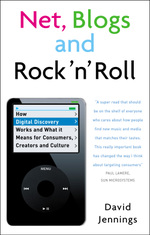
Since this post in 2005, I've written a lot more about this topic in general, and about the music genome project in particular, in my book Net, Blogs and Rock'n'Roll.
Posted by: David Jennings on 14 July 02008 at 10:25 AM
Subscribe to my RSS feed, which covers this blog, my book blog, and further commentary on other web resources (more feeds below)


Fred Garnett on how to create new contexts for your own learning
Elaborating on Agile Learning
David Gauntlett on "making is connecting" and the end of factory learning
Dick Moore on Agile Learning, Agile Software Development and the Mobile Internet
Agile Learning: better results for less money
University of Death by Sean McManus: A Review
Counterculture, Cyberculture and Innovation: the strange case of Stewart Brand
More on self-organised learning
Reflections on Longplayer Live
Progressive austerity and self-organised learning
Round-up of talk and interviews
Applying the lessons of Last.fm to libraries and learning
Support Longplayer Live
Social media old and new: two contrasting networks
Cinema (24)
Cultural Calendar (86)
Curatorial (66)
E-learning (89)
Events (34)
Future of Music (95)
Human-Computer Interaction (62)
Ideas and Essays (36)
Long Now (17)
Miscellany (41)
Music and Multimedia (156)
Playlists (27)
Podcasting (12)
Politics (12)
Radio (48)
Reviews (54)
Social Software (59)
Teaching (20)
Alternatively, see the Date-based Archives
Recommended: RSS feed that combines items on this site, my book blog, and commentary on other web resources

RSS feed for this site only
RSS feed for my book, Net, Blogs and Rock'n'Roll
RSS feed for shared bookmarks
My latest bookmarks (click 'read more' for commentary):
My archived bookmarks (02004-02008)
On most social sites I am either 'davidjennings' or 'djalchemi', for example: Flickr, Last.fm, Ma.gnolia and so on…
Lateral Action — managing creativity
Herd — social cognition
Seb Schmoller's e-learning mailings
Viridian Design Movement
Tom Phillips — artist
Long Now blog — resources for long-term thinking
Longplayer live stream — 1,000-year composition

The contents of this site are licensed under a Creative Commons Licence except where otherwise notified.
Hosted by Paul Makepeace
W3C Standards
Check whether this page is valid XHTML 1.0
Check whether the CSS (style sheet) is valid